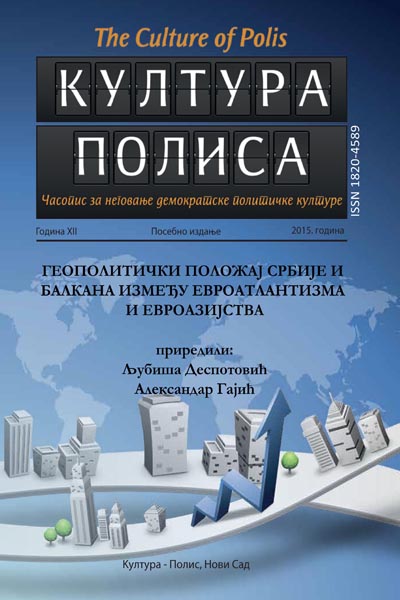
CLASSICAL EURO-ATLANTIC GEOPOLITICAL THEORIES
relevancy at the beginning of the 21st century
Keywords:
geopolitics, geostrategy, Euroatlantism, Eurasianism, USA, NATO, containment policyAbstract
This paper studies the influence and significance of classical Euro-Atlantic geopolitical theories, based on Alfred Mahan’s, Halford Mackinder’s and Nicholas Spykman’s works, on contemporary Europe and also examines their relevancy at the beginning of the 21st century. The importance of the classical geopolitical theories is more and more emphasized, having in mind fact that contemporary world is exposed to a current status quo changes. Showing that two opposed geopolitical concepts are in conflict for decades, in this paper it is stated that the “front line” between them is moved toward East, in favor of euroatlantism, as well as that abovementioned process is not finished yet. At the same time, final remarks of this paper providing insight into a Serbia geopolitical position, in line with contemporary strategic changes, related to Euro-Atlantic and Eurasian concepts influences above all.
Downloads
References
Bžežinski, Zbignjev (2001): Velika šahovska tabla, Podgorica, Banja Luka, CID, Romanov.
Bialasiewicz, Luiza, and Claudio Minca (2005): Old Europe, new Europe: for a geopolitics of translation, Area, 37(4), Royal Geographical Society, Blackwell Publishing Ltd., Oxford: 365-372.
Budimir, Željko M. (2012): Makroregionalnu geopolitičko strukturisanje sveta: aktuelnost Makinderove Hartlend koncepcije, Nacionalni interes, 14(2), Institut za političke studije, Beograd: 223-246.
Vuković, Nebojša (2007): Logika imperije - Nikolas Spajkman i savremena američka geopolitika, Beograd, Konras.
Gray, Collin (1990): War, Peace and Victory: strategy and statecraft for the next century, New York, Simon & Schuster.
Dolman, Everett C. (2002): Astropolitik: Classical Geopolitics in the Space Age, London, Frank Cass Publishers.
Dugin, Aleksandar (2004): Osnovi geopolitike – geopolitička budućnost Rusije, Beograd, Ekopres.
Zarić, Ivan (2009): "Moć mora" u geopolitici i geostrategiji SAD, Nacionalni interes,6(3), Institut za političke studije, Beograd, 131-149.
Kisindžer, Henri (2008): Diplomatija, Beograd, Klub Plus.
Mackinder, Halford (1904): The Geographical Pivot of History, The Geographical Journal 23(4): 421-437.
Mackinder, Halford (1943): The Round World and the Winning of the Peace, Foreign Affairs, 21(4), Council on Foreign Relations, New York: 595-605
Mahan, Alfred T. (1894): Possibilities of Anglo - American Reunion, The North American Review, 159(456), University of Northern Iowa: 551-563.
Mahan, Alfred T. (1900): The Problem of Asia and Its Effect upon International Policies, Boston, Little, Brown, and Company.
Makinder, H. Dž. (2009): Demokratski ideali i stvarnost: Studija politike obnove, Beograd, Metaphysica.
Miršajmer, Džon (2009): Tragedija politike velikih sila, Beograd, Udruženje za studije SAD u Srbiji.
Spykman, Nicholas (1944): The Geography of the Peace, New York, Harcourt, Brace.
Spykman, Nicolas (1942): America`s Strategy in World Politics, The United States and the Balance of Power, New York, Harcourt, Brace.
Stepić, Milomir (2001): U vrtlogu balkanizacije: političko-geografski položaj i fragmentiranost srpskih zemalja, Beograd, Službeni list SRJ, Institut za geopolitičke studije.
Friedman, George, and Friedman, Meredith (1996): The Future of War: Power, Technology and American World Dominance in the 21 st Century, New York, Crown Publishers.
The Withe House (March 2006): The National Security Strategy of the United States of America, dostupno na http://www.comw.org/qdr/fulltext/nss2006.pdf (accessed April 16, 2015).